How to pan for gold in a river?
When people hear the term “gold panning”, many think it’s a complicated and laborious task. However, by ordinary rivers, gold panning is actually a simple exploratory activity. Its core principle is quite straightforward – leveraging the density difference between gold and sand to “sift” gold out of sediment. Today, I’ll share an ultra-simple gold panning method that even beginners can master easily. No complex equipment is needed; just bring some basic tools and you can enjoy the fun of gold panning.
I. Core Preparation for Gold Panning: Only 3 Basic Tools Needed
The key to simple gold panning is “light equipment”. There’s no need for professional sluice boxes or sand pumping devices. The following basic tools are available at ordinary markets, hardware stores, or outdoor supply shops. They are cost-effective and fully meet the needs of beginners:
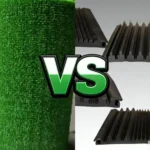
- Core Tool: Gold Pan Easily accessible at regular markets. Prioritize durable hard plastic or metal models (metal ones are more wear-resistant, suitable for stony rivers). The best option is a pan with spiral grooves or grid indentations on the bottom – these grooves act like “traps” to hold tiny gold particles and prevent them from being washed away by rapid river currents. A diameter of 35-45 cm is recommended for beginners; this size can hold enough sand without being too heavy to handle. If you can’t get a professional gold pan right away, you can use a round wooden plate or thick plastic basin with slightly higher edges as a substitute. Just carve a few shallow grooves on the bottom in advance.

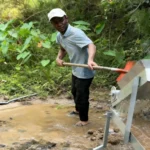
- Extraction Tool: Small Shovel/Engineer Shovel/Bamboo Shovel Used for digging sediment from the riverbed. Choose based on the river environment: if the riverbank has lots of gravel, opt for a foldable engineer shovel with a sharp head (common at hardware stores); if the sediment is soft, a self-made bamboo shovel using locally available hard bamboo is lighter and more cost-effective. A shovel head width of 10-15 cm is ideal, as it allows efficient sand digging while reaching the “old sand layer” deep in the riverbed.

- Auxiliary Tool: Plastic Bucket/Woven Rattan Basket Used for holding sediment to be sifted and for temporary water storage. For plastic buckets, choose a 5-10 liter one with a handle for easy carrying by the river. For a more locally adaptive option, a hand-woven rattan basket works well too – the gaps in the rattan can pre-filter some fine sand, reducing the workload for subsequent gold panning.
- Precision Tools: Small Brush and Tweezers These are easy-to-overlook but extremely useful tools. Choose a small brush with stiff bristles to clean sediment from the grooves of the gold pan; pointed tweezers are ideal for picking up tiny gold particles. Both are available at ordinary general stores at a low cost.
Additional Essential Gear: Some rivers have rapid currents or are dotted with reefs, so a pair of non-slip rubber water shoes (available at regular markets) can prevent slips and injuries. When digging sand, you’ll inevitably come into contact with gravel and sludge, so a pair of wear-resistant canvas gloves will protect your hands. If panning in a remote river, it’s advisable to bring a waterproof bag for storing your phone and documents, along with a small knife (for clearing riverbank weeds and trimming tools) to enhance safety.
II. 4-Step Simple Gold Panning Method: Core Process from Sediment to Gold Particles
In natural rivers, gold distribution follows clear patterns – due to its much higher density than sand, gold naturally settles in areas with slow currents where sand accumulates, such as the inner bends of rivers, the eddy zones beneath large reefs, the “old sand layer” 1-2 meters below shoals, and the confluences of tributaries and main streams. Once you find such locations, follow the steps below. Each step clearly specifies the use of tools, making it easy for beginners to get started quickly.
Step 1: Collect Materials – Digging the Right Sediment is Half the Battle
The core tools for this step are the small shovel/bamboo shovel and plastic bucket/woven rattan basket. Do not dig the surface sand directly; most gold is hidden in the “old sand layer” 30-50 cm underwater, which has a darker color and denser particles (you’ll feel more resistance when digging with a shovel). Insert the shovel vertically into the sand layer, dig a shovel of sediment mixed with sand and mud, and place it in the bucket or rattan basket. Fill the container to half its capacity each time – overfilling will increase the difficulty of carrying and sifting.
Pro Tip: If you find fine black sand (heavy minerals like magnetite) in the sediment, dig more of it – these heavy minerals are often associated with gold and serve as a “gold indicator”.
Step 2: Rough Washing – Remove Large Impurities First
This step is mainly done using the plastic bucket or woven rattan basket. Bring the container with sediment to the water’s edge, fill it with river water to two-thirds capacity, and stir the sediment vigorously with your hand or the shovel handle to fully suspend the mud and fine sand. Then gently tilt the container to pour out the turbid upper water and fine sand – be careful to move slowly to avoid pouring out heavy minerals and gold particles along with them. Repeat this 2-3 times until only gravel and coarse sand larger than 1 cm in diameter remain in the container. This step significantly reduces the workload of subsequent gold panning and improves efficiency.
Step 3: Fine Panning – Core Operation of the Gold Pan
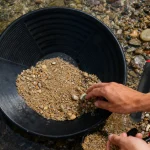
This is the most critical step. The core tool is the gold pan, with the small brush as an auxiliary. The key to the operation is to “use the power of water to separate light and heavy substances”, allowing light sand to be washed away while heavy gold remains at the bottom of the pan.
1. Pour the roughly washed sand into the gold pan, filling it to one-third capacity. Too much sand will make it difficult to control when shaking and prone to spilling.
2. Hold the edges of the gold pan with both hands, tilt the bottom at a 45-degree angle, and slowly lower it into the river water. Ensure the water level just covers the sand in the pan without overflowing the edges.
3. Maintain the tilt angle and gently shake the pan back and forth (with an amplitude of 5-10 cm) while slowly rotating it. This allows the water to flow evenly over the edge of the pan, carrying away the lighter sand. If you encounter clumped sediment during the process, gently break it up with your fingers or the small brush to help separate the light sand.
4. When the sand in the pan is reduced to one-tenth of its original amount, slow down the shaking speed and lower the pan slightly so that the water only covers the fine sand at the bottom. Focus on rinsing the grooves and indentations on the pan bottom; you can use the small brush to gently scrub along the grooves to wash away the sediment hidden in the gaps – gold often remains in these “dead corners”.
Pro Tip: When you spot shiny particles at the bottom of the pan, don’t touch them with your hands immediately. Use the small brush to gently scrub the surrounding fine sand again to ensure the particles are fully exposed. Then use the pointed tweezers to pick them up steadily and place them in a small sealed glass bottle (to prevent the gold particles from being lost).
Step 4: Identification – Confirm Whether It’s Real Gold
Not all shiny particles panned out are gold. In natural rivers, impurities like brass and magnetite are common. Beginners can use the following 3 simple methods for identification, with a small magnet and your fingernail as auxiliary tools: First, check the color – real gold has a soft reddish-yellow hue and won’t glare under light, while brass is brighter with a more “sharp” luster. Second, test the hardness – gently scratch the particle with your fingernail; real gold is soft and will leave a clear mark, while other metals are harder and cannot be scratched. Third, use magnet adsorption – gold is non-magnetic; if the particle is attracted by the magnet, it is an impurity like magnetite.
III. Key Notes for Beginners: 2 Essential Points
1. Safety First: Some rivers may have rapid currents, hidden reefs, or dangerous aquatic organisms. Be sure to choose safe areas where others have been active. If panning alone, inform your companions or relatives of your location and expected return time. After finishing, backfill the pits with the discarded sand and take away all garbage to protect the river ecosystem – this is the basic respect for the natural environment.
2. Keep a Balanced Mindset: It’s difficult for beginners to pan a large amount of gold at once; most finds are tiny “gold dust” or small particles. The fun of gold panning lies more in the process than the result. As you gradually accumulate experience and become familiar with the sand characteristics of different rivers, your efficiency will improve steadily.
IV. Finally: The Essence of Gold Panning is “Patience”
For gold panning in ordinary rivers, the core of this simple method is to use basic tools to amplify the scientific principle of “density difference”. No expensive equipment or complex skills are required. As long as you choose the right sedimentary areas and master the shaking strength of the gold pan, even beginners can experience the joy of discovering gold particles from sediment.