Ultimate guide to fine gold recovery! Compare Centrifuge vs. Vibrating Screen efficiency (98% vs 80%) using real data. Analyze TCO, clay tolerance, and optimal setup for your small gold dredge.
Setting the Tone: The recovery efficiency of fine gold ($<100$ mesh) is the key to determining the profitability of a small gold dredge operation. Traditional sluice methods face significant challenges.
Data Support: Citing industry research, indicate that in a typical gold deposit, the gold particle size distribution shows that approximately $40\%$ of the gold particles are below $150$ mesh ($100 \mu\text{m}$), necessitating high-efficiency technology for capture.
Practical Advice: Regardless of the equipment chosen, it must be recognized that the surface area effect and viscous drag of fine gold are the main obstacles in gravity separation.
A. Centrifuge Principle (Centrifugal Concentrator):
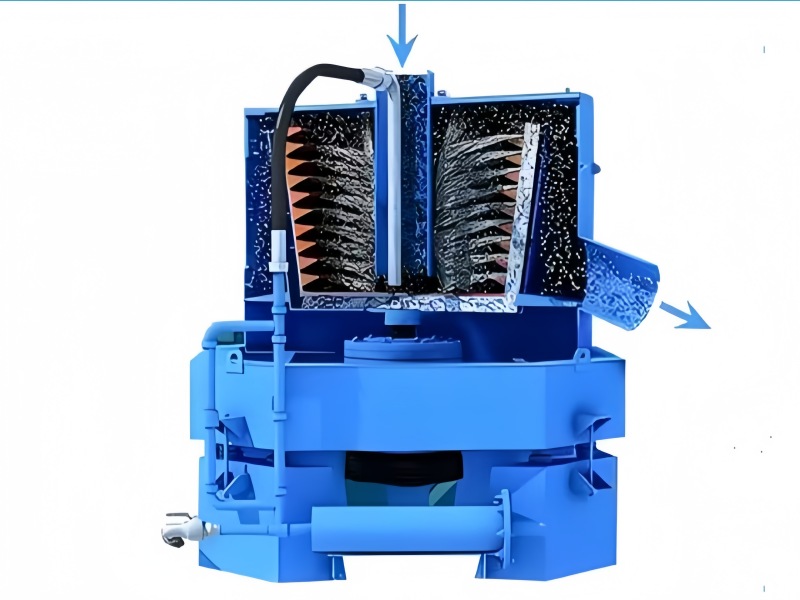
Principle Description: Relies on the powerful centrifugal force ($F = m\omega^2r$) generated by high rotational speeds (typically $60-300 \text{ RPM}$) to press fine gold particles against the inner wall of the catch groove.
Data Support: The centrifuge generates a relative gravitational force (G-force) of up to $60G$ or more, which is crucial for overcoming the viscous drag of the water flow.
Practical Advice: The centrifuge must maintain high and stable rotational speed to ensure a constant G-value, which is necessary for the efficient separation of micro-particles.
B. Vibrating Screen Principle (with Sluice Box):
Principle Description: The vibrating screen is used for classification and washing, while the actual recovery mainly relies on the vibrating sluice box or jigging sluice behind it. The vibration keeps the slurry loose and prevents compaction.
Data Support: A typical vibrating sluice box has an amplitude of about $1 \sim 3 \text{ mm}$ and a frequency of $30 \sim 60 \text{ cycles/minute}$ to optimize the suspended state of the pulp.
Practical Advice: Ensure the tilt angle of the vibrating screen/sluice (recommended $\theta$ between $10^\circ \sim 14^\circ$) and the water flow are balanced to prevent fine gold from being washed away.
A. Centrifuge’s Outstanding Performance:
Key Data: Small modern centrifuges (e.g., $2$-inch or $4$-inch models) can consistently achieve a recovery rate of $\ge 98\%$ for fine gold particles below $150$ mesh when processing concentrates that have passed through a $60$-mesh screen.
Practical Advice: Users pursuing the highest fine gold recovery must use the centrifuge as the final concentration stage in the process, not the primary sorting device.
B. Limitations of Vibrating Screen/Sluice:
Key Data: Even with high-quality vibrating sluice boxes, the recovery rate for gold particles below $200$ mesh typically only reaches $80\% \sim 90\%$. The finer the particle size, the faster the recovery rate drops.
Practical Advice: Use riffled rubber matting and increase the gold catching area, and clean the sluice regularly (e.g., every $2$ hours) to maximize the recovery rate of the vibrating sluice.
A. Centrifuge’s “Cleanliness” Requirement:
Data Support: Centrifuges have extremely strict requirements for the slurry and clay content of the feed. The clay content ($<5 \mu\text{m}$) in the feed is usually required to be no more than $5\%$; otherwise, it can easily affect the flow in the catch groove, leading to clogging or a sudden drop in recovery rate.
Practical Advice: Before using a centrifuge, it must be equipped with sufficient front-end screening and washing equipment (such as a trommel screen) to ensure the feed is clean.
B. Vibrating Screen’s “Tolerance”:
Data Support: With effective washing capabilities, a vibrating screen can handle raw ore with clay content as high as $15\% \sim 20\%$.
Practical Advice: In areas where the water source is turbid and the raw ore contains significant clay (such as certain mountain alluvial deposits), the vibrating screen is a more stable and reliable primary sorting tool.
A. Vibrating Screen: The Workhorse for Continuous Operation:
Data Support: A $6$-inch small vibrating screen (with washing) can easily achieve a raw ore throughput of $5 \sim 10$ tons/hour, suitable for continuous operation.
Practical Advice: If your goal is to maximize raw ore processing speed, you should choose the vibrating screen as the core process, using the centrifuge only for secondary concentration.
B. Centrifuge: The Concentrator for Batch Operation:
Data Support: Centrifuges typically operate in batches (intermittently). Their throughput is relatively smaller (e.g., $1 \sim 3$ tons/hour for a $4$-inch model) and they require periodic shutdowns for concentration (usually $15$ minutes every $4$ hours).
Practical Advice: Optimize the concentration time and ensure the efficiency of the shutdown process, feeding the pre-concentrate to the centrifuge in batches.
A. Centrifuge: High Initial Cost, Fine Operation:
Data Support: Due to the precision bearings and high-power motors involved, the initial purchase cost of a centrifuge is typically $30\% \sim 50\%$ higher than a vibrating screen of comparable throughput.
Practical Advice: Maintenance focus for centrifuges is on the bearings and seals. It is recommended to check the lubricant and seals every $500$ operating hours.
B. Vibrating Screen: Low Energy Consumption, More Wear Parts:
Data Support: The energy consumption of a vibrating screen is relatively low (typically $1.5 \text{ kW}$ is enough to drive a $4$-inch model), but wear parts (screens, rubber mats) are replaced frequently, with annual consumable costs estimated to be $5\% \sim 10\%$ of the equipment price.
Practical Advice: When purchasing, choose high-wear-resistance polyurethane screens and quality riffled capture mats to reduce long-term consumable costs.
A. Centrifuge: Requires Professional Operation:
Data Support: The startup, speed adjustment, and wash water pressure of the centrifuge must be precisely controlled. The recommended startup water pressure is maintained at $0.05 \sim 0.1 \text{ MPa}$.
Practical Advice: Purchase centrifuges with automatic timed discharge or variable frequency drive (VFD) speed control systems to reduce human operating error.
B. Vibrating Screen: Simple and Robust Maintenance:
Data Support: Operation of the vibrating screen mainly focuses on adjusting the water flow and inclination angle, requiring less specialized technical knowledge.
Practical Advice: At the end of daily operation, the screen should be checked for damage, and residual mud should be cleaned off the screen surface with a water gun to prevent compaction.
Scenario Description: Individual prospector, limited budget, pursuing high recovery.
Configuration Recommendation: $2$-inch Manual Centrifuge (for concentration) + Mini Vibrating Sluice (for pre-concentration).
Data Support: Manual centrifuges are light (approx. $15 \text{ kg}$) and portable. The mini sluice can process up to $\mathbf{2}$ tons of raw ore per day.
Practical Advice: Adopt a “bulk primary sorting, fine particle concentration” strategy: pass the raw ore through the sluice first, then feed the sluice concentrate into the centrifuge.
A. Optimal Centrifuge Parameters:
Key Data: Optimal rotational speed for fine gold recovery: the resulting centrifugal acceleration $A_{\text{c}}$ should be at least $60$ times the gravitational acceleration $G$.
Practical Advice: Regularly check the motor speed gauge and avoid overspeeding or underspeeding, as both lead to reduced recovery efficiency.
B. Vibrating Screen/Sluice Optimization:
Key Data: The optimal excitation force of the vibrating screen should be kept within a range that causes the material to jump about $1 \text{ mm}$, as too much force can cause fine gold to be ejected from the capture mat.
Practical Advice: When adjusting the vibration frequency, observe the laminar flow state of the water and sand on the sluice to ensure heavy material settles and light material remains suspended.
Summary: The centrifuge vastly outperforms the vibrating screen in fine gold recovery rate, but requires cleaner feed and more precise operation; the vibrating screen excels in throughput, adaptability to harsh conditions, and initial cost.
Decision Tree Flow (Text Version):
Is the primary goal to recover $<100$ mesh fine gold? $\to$ Yes: Choose Centrifuge. $\to$ No: Proceed to 2.
Is the ore area high in clay and sediment? $\to$ Yes: Choose Vibrating Screen for primary sorting. $\to$ No: Proceed to 3.
Does the budget allow for purchasing both types of equipment? $\to$ Yes: Optimal Solution: Vibrating Screen + Centrifuge (Combined Process). $\to$ No: Make a trade-off based on the primary goal.
Final Recommendation: For prospectors seeking commercial profitability, the combined process (Vibrating Screen for primary sorting + Centrifuge for concentration) is the only best solution to achieve high throughput and high recovery rate.
Your email address will not be published. Required fields are marked *